Tehanu
Earthsea, Book 4
Ursula K. Le Guin
★★★★★
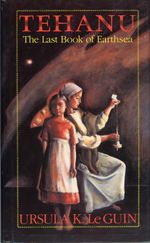
And while there are still big fantastic questions like the connection between humans and dragons, it delves into weightier but more personal issues like child abuse, disability, misogyny and cruelty.
A Life More Ordinary
Tehanu picks up Tenar’s story 25 years after she left Atuan with Ged. She’s since walked away from the life of priestesses, mages and kings, and lived an ordinary woman’s life as a farmer on Gont, marrying, raising children, widowed, and as the story begins, adopting an abused, scarred child.
And it picks up Ged’s story a few hours after he left Roke on the back of a dragon, his magic spent closing the hole in the world, as he has to learn how to carry on as an ordinary man.
What follows is a character-driven drama that interplays with philosophical conversations. What is a woman’s magic vs. a man’s magic? Why are witches considered weaker (and more wicked) than their more-respected sorceror counterparts? And what is a man’s magic compared to the man himself? Ged has lost his magic, yes, but he still tends to find himself in the right place at the right time to do what is needful, though he has fewer options than he did before. And while he grew up surrounded by men, and still sees power as a male thing, he hasn’t absorbed the casual sexism of the villagers or the utter disdain of wizards like Aspen of Re Albi.
From Burned to Burning
And then there’s Therru. Tenar is the one to adopt her precisely because she doesn’t believe in the just-world fallacy. She’s lived next to actual evil powers, and she knows better than anyone on Gont that who you are and what happens to you are not the same thing. Everyone around them sees Therru’s scars, or frets about what kind of magic potential she has, but Tenar is just trying to raise a traumatized child as best as she can.
Watching Therru come out of her shell is a joy, and seeing her close up again when her abusive former family catches up to her hurts. One of the best moments of the book is when we finally see through her point of view: how she sees her adoptive family, how she sees magic and other wizards…and of course how she sees dragons.
The end is a bit abrupt, but that’s a consequence of the perspective: As a middle-aged couple with no title and no magic, Ged and Tenar can deal with mundane issues like burglars and thieves on the road, but they’re utterly defenseless against a malicious wizard who still has his power.
Then again, Aspen is not a dragonlord.
Duality
By this time Le Guin was much more focused on duality than when she wrote the earlier books, and considering that the first one is about someone coming to terms with his shadow, that says something. There are a lot of dualities in this story: Human/dragon, male/female, reputable people who are horrible in private and disreputable people with good hearts…
The Break
It probably hit differently for people who read the trilogy in the early 1970s and eagerly picked up Tehanu, only to find it wasn’t what they were expecting. I read it the first time when it was new, but I’d only read the trilogy a year or two earlier. To me, Earthsea was still alive and changeable, not something that had solidified when I was younger, and it was just the next chapter.
I can sort of understand readers who didn’t want Tenar to walk away from the world of heroes, though that choice is hinted at as early as within the second book. And I can sort of understand readers who didn’t want to read about Ged trying to carry on as a goatherd after using up all his magic.
Sort of.
But I wonder how much overlap there is with the readers who thought The Tombs of Atuan was Ged’s story and not Tenar’s, and thought it odd that “the main character” didn’t show up for half the book.
More info at Tehanu.