The Secret of the Candlesticks
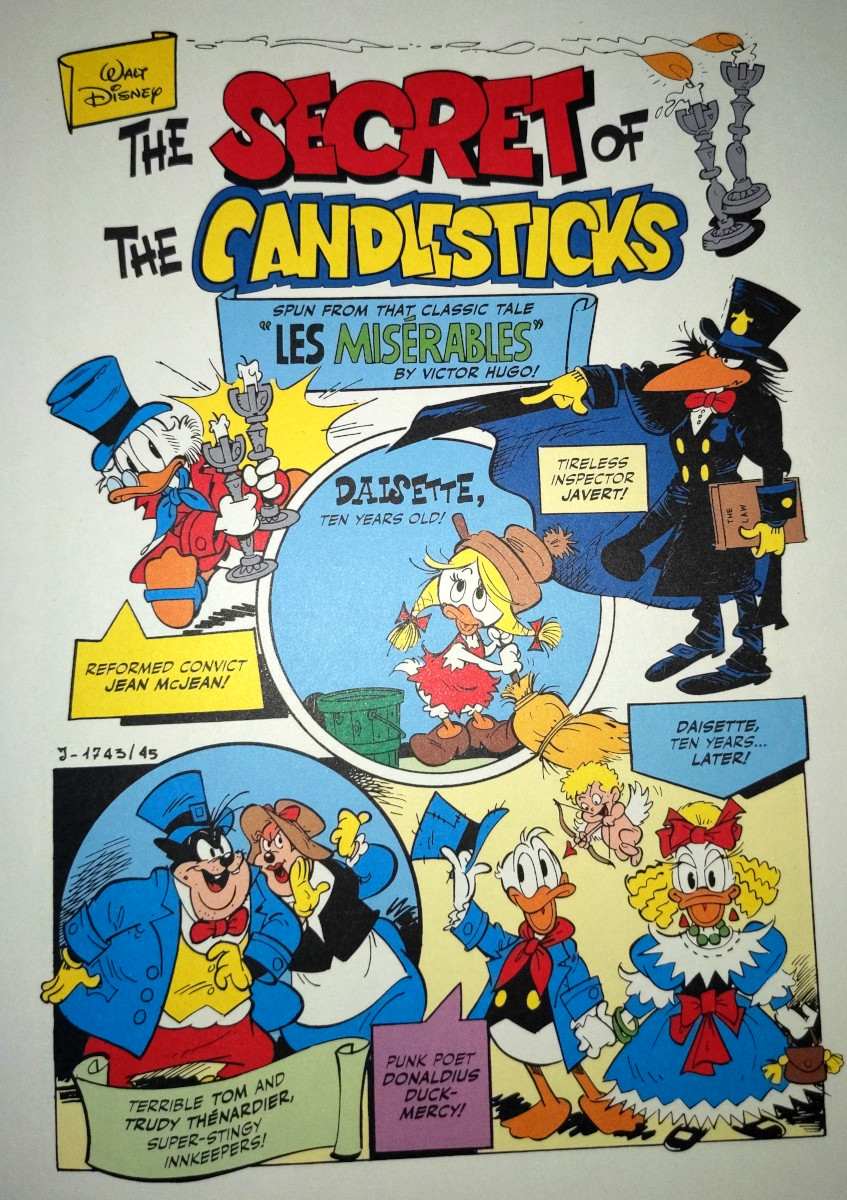 I hope you’ll excuse me for saying that “The Secret of the Candlesticks” is a bit of an odd duck. It starts out as a comedic adaptation of Les Misérables with Uncle Scrooge as Jean McJean, Daisette, Donaldius Duckmercy and the rest. Then it takes a swerve and turns into a treasure hunt.
See, the bishop had bought the candlesticks from a secondhand seller, who bought them from Thénardier, who stole them from one of Napoleon’s supply wagons at Waterloo, and Napoleon had collected them from the royal treasury, and they were keys to an ancient royal treasure…
No, seriously! Well, OK, not seriously.
On top of that, there’s a framing sequence in which Uncle Scrooge tells Huey, Dewey and Louie the story of his ancestor Jean McJean, claiming that Victor Hugo adapted his story (with “a few changes”). The nephews are impressed, even if Donald remains skeptical.
And yet it actually works! Madcap twists and turns, character adaptations that fit, references galore to both the stage musical and the book. There are three urchins, Huvroche, Dewvroche and Louvroche. Parisian landmarks and landscapes abound, from the depths of the Seussian sewers to the (anachronistic, but wonderfully detailed) spire of Notre Dame. Peg-Leg Pete and Trudy are a perfect fit for the Thénardiers, and even Patron-Minette is represented, here by the Beagle Boys (who else?).
Inspector Javert is a raven character I don’t recognize. According to the afterward, he appeared in Carpi’s other literary parodies, but it doesn’t give his name. If he even has one. And now I’m thinking about the whole malleability of identity that runs throughout the novel.
Carpi remarks that they changed the title to justify changing the tone: his version needed not just comedy, but an actual happy ending. And if it wasn’t actually called Les Mis, that opened up other story possibilities to bring that about. Specifically, he mentions adding “elements from Eugene Sue’s The Mysteries of Paris.” I’m not familiar with it, but it seems to be a novel where a mysterious man in Paris goes around helping the downtrodden, so I can see why.
Giovan Battista Carpi’s take on the story, originally in Italian, was published in 1989 across three issues of Topolino. The English translation is currently available in hardcover, together with the same artist’s duck-ified War and Peace.